What Was SIREN, and Why Did It Collapse by 96%?
As institutional capital has settled into Bitcoin and Ethereum, speculative liquidity has kept chasing riskier corners of the market, particularly projects blending AI narratives with meme-coin culture. SIREN became one of the more striking examples of that trend gone wrong.
The token launched with claims of powering an AI-driven trading revolution. Within a short window, it went from a billion-dollar peak valuation to near-zero, losing more than 96% of its value.
This wasn't a routine correction tied to broader market cycles. On-chain evidence points to something closer to a fully engineered liquidity event, one that goes beyond the classic pump and dump model and into what analysts are now calling a leveraged scam: a scheme that exploits derivatives market structure, cross-exchange pricing mechanisms, and liquidity depth differences to extract value from retail traders.
This breakdown walks through SIREN's origin story, the mechanics behind the manipulation, the capital flows during the collapse, and how German and EU regulators are positioned to respond.
The SIREN Project: Concept vs. Reality
SIREN launched as a BEP-20 token on BNB Chain via the Four.meme launchpad, marketed around the peak of the AI-agent narrative. The anonymous team behind it introduced SIREN as an "AI trading assistant with a dual personality," drawing on Greek mythology for branding.
The marketing built around two distinct AI personas: Golden Siren, positioned as a cautious, analytical agent focused on trading signals, macro insight, and portfolio analysis, and Crimson Siren, a more aggressive, momentum-driven counterpart aimed at capturing high-volatility opportunities. The roadmap promised an AI-powered decentralized exchange with smart order matching, automated risk management, natural-language trading bots, and cross-chain bridges extending beyond BNB Chain.
None of it materialized. Independent research found no deployed mainnet product, no public code repository, no functioning DEX, and no smart contract audits. When the project collapsed, the website went offline and social channels were abandoned. What remained was a simple, transferable token with a set of graphics behind it built to attract liquidity from investors unaware of what wasn't actually there.
Absolute Supply Control: The Hidden Architecture
SIREN's crash wasn't driven by organic supply and demand. It was the outcome of near-total control over token supply and float liquidity.
Months before the June 2026 collapse, on-chain researchers including ZachXBT and the wallet-visualization platform Bubblemaps had already flagged dangerous supply concentration. Using wallet clustering, analyst EmberCN found that of SIREN's top 54 holder addresses (excluding burn addresses and exchange wallets), 52 were controlled by a single entity.
The controlling entity used address fragmentation spreading holdings across hundreds of small, unrelated wallets with clean transaction histories to evade whale-detection tools. At its peak in March 2026, this entity's holdings were valued between $1.44B and $1.7B.
When a single entity controls more than 90% of spot supply, standard technical analysis loses meaning. Candlestick charts stop reflecting collective market behavior and start reflecting a script written by whoever controls the float.
From Pump-and-Dump to Leveraged Scam: The Five-Phase Playbook
What separates SIREN from a classic pump-and-dump is its use of derivatives market structure not just spot market hype but to generate outsized returns. Analysts have broken the mechanism into five distinct phases.
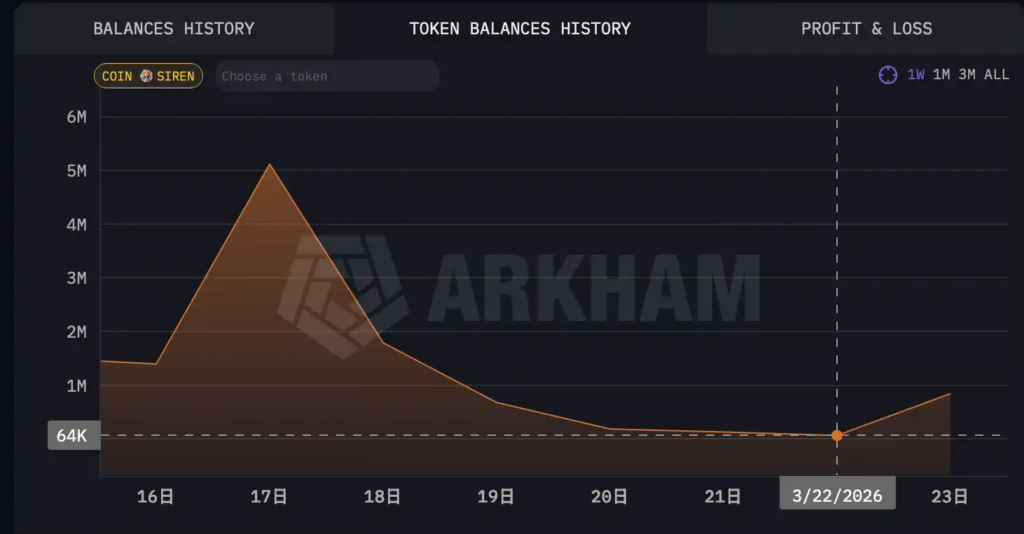
Phase 1: Spot Accumulation and Liquidity Engineering The controlling entity quietly accumulated tokens near $0.045 in June 2025, draining free-float liquidity from both centralized and decentralized exchanges. By March 22, 2026, Arkham Intelligence data showed Gate.io held just 64,000 SIREN tokens in total reserve, a float so thin that a single $100,000 order could move the one-minute chart by 40%.
Phase 2: Index Price Manipulation Perpetual futures on major exchanges like Binance typically price off a weighted average of spot prices across multiple venues a design meant to resist manipulation. The controlling entity exploited this by generating artificial volatility on thinly-traded venues like Gate.io and KuCoin, which fed directly into Binance's futures index price. The distortion was severe enough that Binance repeatedly adjusted exchange weightings in its index formula, reportedly cutting Gate.io's weight from 50% to 25% while raising its own internal Binance Alpha weighting from 25% to 50%. A defensive move that came only after the damage was done.
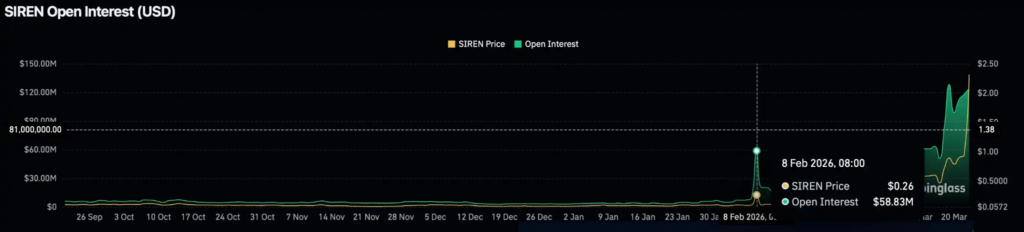
Phase 3: Engineering a Short Squeeze As SIREN spiked more than 30x from $0.08 to a peak of $3.83 professional traders and retail shorts, spotting an obvious bubble, piled into leveraged short positions. That was exactly the trap. Open interest, which had hovered around $3–5 million for months, suddenly spiked to $58.83 million.
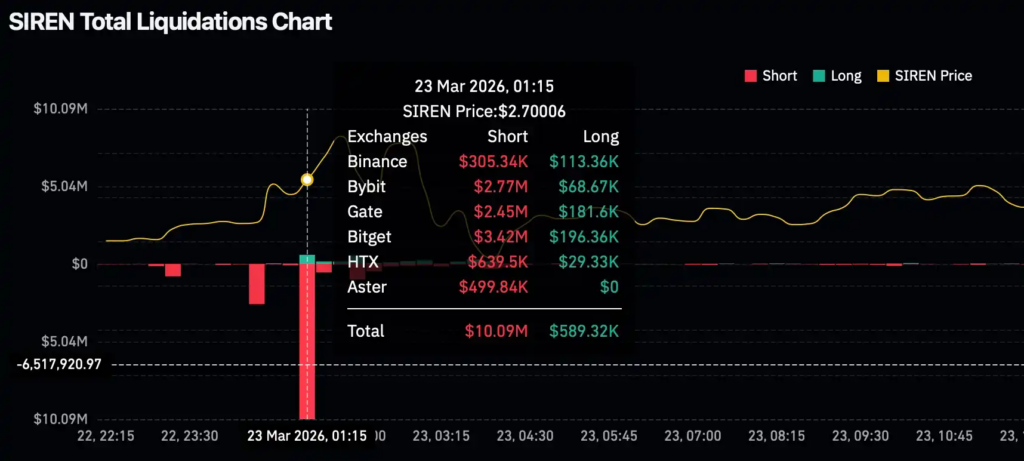
Phase 4: Milking Funding Rates Because the controlling entity refused to let spot price fall, futures consistently traded below spot pushing funding rates deeply negative. From March 14 onward, short sellers were forced to make continuous payments to long holders (the same controlling entity), which were then recycled into further pumps. A 78% price swing within 10 minutes on Gate.io on the morning of March 23 triggered mass liquidation of short positions.
Phase 5: The Double Kill Once funding-rate extraction peaked, the operator closed long positions at the top, opened large new shorts, and simultaneously dumped previously hoarded spot supply into the market. The resulting sell pressure crushed spot holders while generating outsized profit on the newly opened shorts. This "double kill" pattern has reportedly appeared before in tokens like LAB, RIVER, BEAT, and VELVET.
Notably, after price bottomed near $0.05, hundreds of new small wallets began quietly re-accumulating tokens in small increments, a pattern analysts attribute to the same controlling entity, potentially setting up a future cycle.
The DWF Labs Question
Analysts have flagged wallet-behavior overlaps between SIREN's controlling addresses and wallets previously linked to market maker DWF Labs in prior projects like LADYS and RACA. The concern centers on a specific market-making model: instead of profiting from bid-ask spreads, some "active market makers" reportedly receive large token allocations at zero cost from project teams, then gradually offload them onto retail under the guise of liquidity provisioning splitting profits with the team.
DWF Labs co-founder Zac has publicly denied any involvement in the SIREN case. Still, the recurrence of similar patterns across multiple token collapses has intensified scrutiny of market-making contract transparency across the industry.
How Germany and the EU Are Responding

Germany's financial regulator, BaFin, has placed crypto-related social engineering and finfluencer-driven scams at the top of its 2026 risk priorities, noting that over half of German investors aged 18-45 get financial information directly from social platforms like YouTube, Telegram, and Discord. BaFin issued more than 100 formal warnings about scam groups on social media in 2025 alone.
Under MiCAR, fully enforceable across the EU since December 30, 2024, and implemented in Germany through the KMAG and FinmadiG frameworks, cases like SIREN carry serious legal exposure:
- Market abuse (Title VI, Articles 86-87): Artificial volume creation and index-price manipulation to extract futures profits qualify as clear market manipulation.
- Disclosure failures (Article 88): Failing to disclose a decision to dump 94% of supply is a direct violation, classified under KMAG Section 47 as a serious administrative offense.
- Criminal liability (KMAG Section 46): Unlicensed crypto services and organized market manipulation can carry prison sentences up to 5 years, rising to 10 years in cases involving large-scale investor losses, such as SIREN's $64.8M extraction.
- Exchange obligations (CASPs/PPAET): Licensed exchanges are legally required to detect, prevent, and report market abuse. Allowing tens of millions in proceeds to move through their platforms exposes them to AML violations and regulatory penalties.
The Bottom Line for Traders
SIREN's collapse wasn't a market accident, it was a five-phase engineered exit built on supply monopolization, index-price exploitation, and derivatives-market mechanics that most retail traders never see until it's too late.
The broader lesson isn't specific to SIREN. Any token where a handful of wallets can plausibly control 90%+ of float should be treated as a structural red flag, regardless of the narrative wrapped around it AI, RWA, or otherwise. Thin order books on low-tier exchanges, unverifiable roadmaps, and unusually stable funding rates are all worth checking before sizing a position.