Toncoin Is Now GRAM: What Traders Need to Know About TON's 2026 Rebrand
One of crypto's most recognizable tokens has officially changed its name. Toncoin, known across exchanges by its TON ticker, has reverted to GRAM. The blockchain itself remains The Open Network (TON), but the token that powers it is once again using the name it carried before Telegram was forced to abandon the original project in 2020.
For anyone holding TON, trading it, or wondering why wallets and exchanges have started displaying a different asset name, here's what changed, why it happened, and what it could mean going forward.
From GRAM to Toncoin and Back Again
The origins of this story go back to January 2018, when Telegram founders Pavel and Nikolai Durov unveiled plans for the Telegram Open Network. The goal was to build a scalable, multi-chain ecosystem capable of supporting decentralized applications, smart contracts, and digital identity services. At the center of that ecosystem was a native token called GRAM, designed to function as a payment layer integrated directly into Telegram.
To finance the project, Telegram conducted one of the largest private fundraising rounds in crypto history. Through SAFT agreements, the company raised $1.7 billion from 171 investors, promising a total of 2.9 billion GRAM tokens once the network went live.
The project's momentum came to a halt in October 2019 when the SEC filed an emergency action, arguing that the GRAM sale constituted an unregistered securities offering. In March 2020, a federal judge sided with the regulator, ruling under the Howey Test that the SAFT agreements and the planned token distribution formed a single public offering. Telegram officially withdrew from the project in May 2020 and reached a settlement with the SEC the following month, returning $1.2 billion to investors and paying an $18.5 million penalty.
Although Telegram stepped away, the network's open-source code survived. An independent community of developers continued building the project under a new identity, rebranding it as The Open Network and renaming the token Toncoin to distance it from Telegram's legal issues. The network's five billion token supply was distributed primarily through proof-of-work mining contracts between 2020 and 2022, despite the blockchain itself operating on a proof-of-stake consensus model. The result was an unusual distribution process that left a sizable share of the supply in the hands of early participants.
The MTONGA Roadmap and Telegram's Return
For several years, Telegram maintained a cautious distance from TON. That changed in 2026.
Pavel Durov announced that Telegram would take a more active role in the ecosystem, becoming the network's largest validator and positioning itself as a key driver behind a seven-phase initiative known as "Make TON Great Again" (MTONGA).
The first stages of the roadmap focused on infrastructure improvements. A Catchain 2.0 upgrade reduced block production times from roughly 2.5 seconds to around 400 milliseconds, while a revised fee structure lowered base transaction costs to approximately $0.0005, representing a sixfold reduction. Telegram also designated TON as the exclusive blockchain infrastructure for its growing ecosystem of Web3 mini-apps.
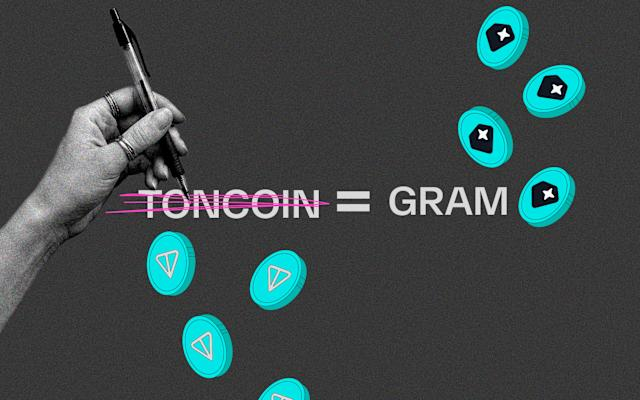
The fourth phase introduced the most visible change. On June 1, 2026, Durov announced plans to restore the token's original GRAM branding and submit the proposal for community approval through on-chain governance.
How the Rebrand Actually Happened
One detail that often gets overlooked is that the rebrand was not implemented unilaterally by Telegram.
The proposal was submitted through TON Vote, with voting power determined by TON balances recorded in a snapshot taken on May 31, 2026. Voting remained open from June 1 through June 8, ultimately passing with 81.22% support.
The official ticker transition took place at 12:00 UTC on June 15, 2026. Exchanges, wallets, and blockchain explorers were given until that date to update their interfaces, while full ecosystem-wide consistency was expected by June 22. To minimize confusion, many platforms adopted temporary labels such as "Gram (prev. Toncoin)" before eventually removing references to the former name.
Most importantly, this was a rebrand rather than a token migration. Users were not required to swap assets, bridge funds, or complete any claim process. Wallet balances, staking positions, NFTs, and smart contracts remained unchanged throughout the transition. The network continues to operate using the same proof-of-stake consensus mechanism; only the token's name and ticker have changed.
Market Reaction: A Sharp, Fast Move
Traders reacted long before the rebrand became official.
Following Durov's announcement on June 1, TON surged roughly 15% to 19% within hours, while 24-hour spot trading volume more than doubled. Reports at the time highlighted a move toward the $2.20 to $2.30 range, marking a multi-month high as traders positioned themselves around the narrative ahead of the actual ticker change.
The market response offers an interesting lesson for event-driven traders. The announcement generated far more price movement than the technical implementation itself. By the time the rebrand officially went live on June 15, much of the repricing had already occurred. The rally also coincided with a broader risk-on environment across crypto markets, driven in part by unrelated geopolitical developments during the same period.
For traders watching GRAM closely, the setup resembles a classic combination of headline-driven momentum, partial profit-taking, and a secondary catalyst layered on top. Situations like these often lead to volatile, range-bound trading conditions rather than a sustained directional trend, making patience more valuable than chasing short-term moves.
Regulatory Context Has Shifted Since 2020
The GRAM name inevitably brings back memories of the regulatory battle that halted Telegram's original plans.
However, the environment in 2026 looks very different from what existed in 2019. Regulatory approaches toward decentralized utility networks have become clearer and, in many cases, more accommodating. While that does not eliminate legal uncertainty entirely, it has reduced some of the concerns that surrounded the project during its first attempt.
There is also the matter of the MTONGA roadmap itself. Three phases remain undisclosed, meaning Telegram's influence over the network is likely to expand further before the initiative is complete. Each future phase introduces new opportunities, but also new regulatory and market risks.
What This Means If You Hold TON
For existing holders, the practical impact is straightforward: no action is required.
There is no migration process, no conversion deadline, and no need to move funds between wallets. As exchanges and wallet providers complete their updates, balances will simply appear under the GRAM name instead of Toncoin.
The more important question is whether Telegram's growing influence over the network introduces risks that the market has yet to fully price in. A platform with roughly 950 million users controlling the largest validator stake on a network that promotes decentralization is a unique situation within the crypto industry. How that balance evolves over time could have a greater impact on GRAM's future performance than the name change itself.
Final Thoughts
The transition from Toncoin to GRAM is more than a cosmetic rebrand. It represents another step in Telegram's effort to strengthen the connection between its messaging ecosystem and a Layer 1 blockchain network.
Whether that strategy succeeds will depend on how effectively the remaining MTONGA phases are executed, how the market responds to validator concentration and supply distribution concerns, and whether regulators maintain the relatively constructive stance seen throughout 2026.
For traders and investors, the most valuable signals will likely come from on-chain activity, validator distribution, and exchange adoption rather than the rebrand headline alone. If you're looking for real-time analysis as the remaining MTONGA phases unfold, that's exactly the type of market development we cover inside our Telegram community.