Circle Gets Historic Bank Charter; Is USDC Officially Entering the U.S. Banking System?
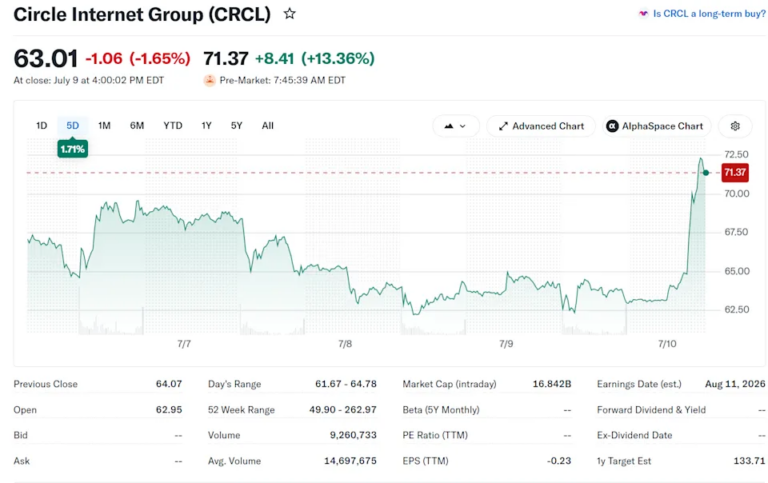
Circle, the issuer of USDC, has received approval to operate as a federally supervised bank. Shares of Circle Internet Group (NYSE: CRCL) jumped nearly 15% on the news, marking one of the stock's strongest moves since its rocky summer trading run.
Key takeaways:
- Circle received final approval from the Office of the Comptroller of the Currency (OCC) to operate as a federally supervised bank
- The announcement drove Circle's stock up roughly 15%, recovering part of its steep prior decline
Why Did Circle's Stock Rally After OCC Approval?
According to Yahoo Finance, Circle received final approval to establish a national bank under U.S. federal government supervision, and the recent stock rally recovered part of its recent steep decline. The move comes after a difficult stretch for CRCL, which had fallen from a 52-week high near $263 down to roughly $63.
For a stock that had lost more than three-quarters of its value from its peak, federal bank approval landed as a meaningful catalyst, not just a regulatory formality.
From Conditional Approval to a Full National Trust Charter
The OCC granted Circle approval to launch Circle National Trust, its new banking entity. This clears the conditional approval Circle received in December 2025, converting it into a full charter.
Circle originally filed for the bank charter in June 2025. It was one of five crypto-focused companies to receive conditional approval that December, alongside Ripple and Fidelity, placing Circle in a small group of digital asset firms moving toward direct federal bank supervision.
Once operational, the bank will custody Circle's digital assets and those of affiliated entities. Just as importantly, it opens the door to managing USDC reserves under direct federal oversight, bringing those reserves formally under the GENIUS Act, the 2025 law that established a regulatory framework for U.S. stablecoins.
CEO Jeremy Allaire on Federal Oversight
Circle co-founder and CEO Jeremy Allaire welcomed the added scrutiny that comes with the charter. In a company statement, he said federal oversight of the trust bank sets a new standard for transparency, governance, and scalability across Circle's infrastructure.
For a stablecoin issuer, that kind of regulatory clarity often matters as much to institutional counterparties as it does to retail users, it's a signal of durability, not just compliance.
Stock Recovery After Weeks of Pressure
Circle shares had dropped roughly 15% in late June after Visa, Coinbase, and several other companies threw their support behind a competing stablecoin, Open USD, a move seen as a direct threat to USDC demand.
That pressure eased following the OCC news. Circle's stock traded around $72.15 in Friday premarket action, up from Thursday's $63.01 close, a move that added more than $2 billion to the company's market cap in a single session.
The Open USD concern hit hard because USDC is Circle's core business. USDC's market cap currently sits around $73 billion, making it the fifth-largest crypto asset by market value. It remains behind USDT, but its footprint across domestic markets continues to expand.
Institutional Investors Are Buying the Dip
Some investors used the pullback as an entry point. Cathie Wood's ARK Invest bought roughly 217,900 Circle shares worth about $13.7 million on July 9, one day before the charter announcement.
On the same day, ARK sold roughly $9.8 million worth of Robinhood (HOOD) shares. Trading disclosures show ARK has invested more than $37 million into Circle stock over the past eight weeks alone, a notable conviction bet heading into the charter decision.
Wall Street Remains Bullish on Circle
Wall Street analysts have largely stayed positive on CRCL through the volatility. The average rating remains "buy," with a 12-month price target near $134, significantly above current trading levels.
What This Means for USDC Holders
Retail USDC holders won't see any immediate operational change from the charter itself. But the market's reaction suggests investors believe federal oversight could accelerate USDC adoption among financial institutions, a trend already underway as some banks have started integrating USDC into their operations.
One caveat worth keeping in mind: premarket stock gains don't always hold once regular trading begins. Traders watching CRCL should treat the current move as a strong signal, not a guaranteed continuation.