Grayscale Names 5 DeFi Altcoins With Strong Fundamental Value Potential
Grayscale Research has identified five decentralized finance (DeFi) altcoins that it believes currently offer strong fundamental value as the cryptocurrency market gradually shifts toward more mature valuation frameworks.
According to the investment firm, projects capable of generating real revenue, sustainable cash flow, and transparent token economics are increasingly attracting investor attention as market participants move away from purely speculative narratives.
The five projects highlighted by Grayscale are:
- Hyperliquid (HYPE)
- Aave (AAVE)
- Uniswap (UNI)
- Sky (SKY)
- Maple Finance (MAPLE)
The report reflects a broader market transition where investors are starting to value crypto assets more like traditional financial businesses.
Why Grayscale Is Becoming Increasingly Bullish on DeFi
The broader crypto market has remained relatively weak since the beginning of the year, with many digital assets struggling to maintain bullish momentum.
However, Grayscale argues that this environment is forcing investors to rethink how crypto assets should be valued.
Instead of viewing tokens solely as speculative instruments, the firm believes many blockchain projects (particularly DeFi protocols) can now be evaluated as revenue-generating digital financial businesses.
Grayscale categorizes crypto assets along a valuation spectrum.
At one end sits Bitcoin (BTC), which behaves more like a digital commodity.
At the other end are DeFi protocols that generate recurring revenue streams and increasingly resemble traditional financial companies with measurable cash flow.
This shift could significantly change how investors approach long-term crypto valuations.
DeFi Protocols Have Generated Nearly $25 Billion in User Fees
One of the strongest arguments supporting Grayscale’s thesis is the growing amount of on-chain economic activity.
According to the report, since 2023, DeFi protocols have collectively generated nearly $25 billion in cumulative fees from real users.
This growth has been driven by expanding activity across multiple sectors, including:
- Decentralized exchanges (DEXs)
- Lending protocols
- Staking infrastructure
- On-chain derivatives markets
As blockchain usage matures, protocols with sustainable fee generation are becoming increasingly attractive to both institutional and retail investors.
Lower Valuation Ratios Suggest DeFi Business Models Are Maturing
Grayscale also noted that valuation ratios across DeFi lending protocols have declined over recent market cycles.
Rather than signaling weakness, the firm interprets this as evidence that DeFi business models are becoming more mature and are now trading at more attractive valuation levels.
For long-term investors, this could represent a shift from speculative pricing toward more rational market behavior.
As institutional capital enters the sector, traditional financial metrics are likely to play a larger role in determining token valuations.
Revenue Alone Is Not Enough to Increase Token Value
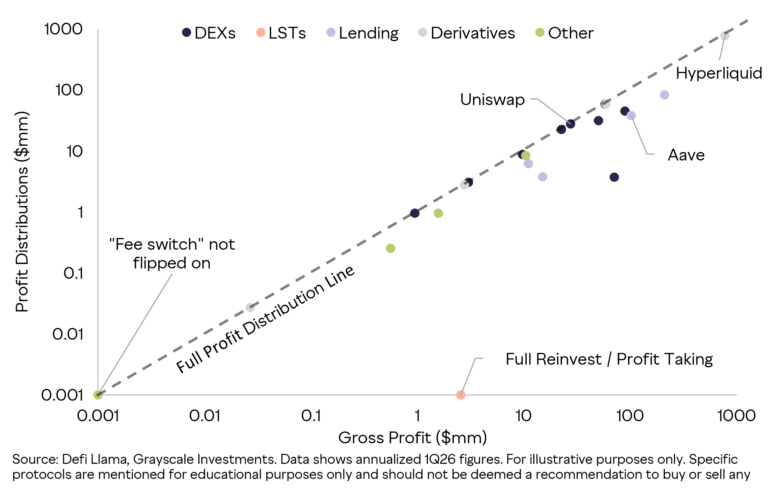
One of the most important takeaways from the report is that high protocol revenue does not automatically create token value.
Grayscale emphasized that the way revenue is distributed within a protocol matters far more than the total amount generated.
Several mechanisms determine whether token holders actually benefit from protocol growth, including:
- Token burn mechanisms
- Token buybacks
- Staking rewards
- Revenue-sharing models
- Incentive distribution systems
Without clear value transfer to token holders, strong protocol revenue may have limited impact on price performance.
This remains one of the most overlooked factors in DeFi investing.
Uniswap and Hyperliquid Stand Out in Token Value Distribution
Among the five projects highlighted, Uniswap (UNI) and Hyperliquid (HYPE) were identified as particularly strong examples of efficient token economics.
According to Grayscale’s analysis, both projects return nearly 100% of generated revenue back to token holders through transparent economic mechanisms.
This direct connection between protocol activity and token value makes both assets stand out in the current DeFi landscape.
The report suggests these models are becoming increasingly important as investors begin prioritizing measurable value capture over speculative narratives.
Hyperliquid’s Buyback Model Is Driving Rapid Growth
Grayscale specifically highlighted Hyperliquid’s economic structure as one of the strongest examples of effective token value accumulation.
The protocol uses trading fees directly to buy back and burn HYPE tokens, creating continuous demand tied directly to platform activity.
This mechanism has contributed significantly to Hyperliquid’s rapid expansion.
As a result, HYPE has already entered the top 10 largest cryptocurrencies by market capitalization this year, reflecting growing market confidence in its economic design.
For traders monitoring DeFi trends, Hyperliquid remains one of the most closely watched projects this cycle.
AAVE Continues to Trade Below Estimated Fair Value
The report also highlighted Aave (AAVE) as the largest lending protocol in the DeFi sector.
Grayscale recently stated in a separate report that AAVE may currently be undervalued, noting that when the token was trading near $75, it appeared to be priced below its estimated fair market value.
This reinforces growing institutional confidence in DeFi lending platforms that continue to generate strong recurring revenue.
As decentralized lending adoption expands, Aave remains one of the sector’s most established infrastructure projects.
Crypto Markets Are Moving Away From Narrative-Driven Investing
In its final conclusion, Grayscale argued that the cryptocurrency market is undergoing a structural transformation.
According to the firm, crypto valuations are gradually shifting away from trend-driven speculation and narrative-based investing toward more disciplined models focused on fundamental economic performance.
The report states that protocols capable of:
- Generating real revenue
- Managing capital efficiently
- Maintaining transparent tokenomics
- Returning value directly to token holders
will likely outperform weaker projects in future market cycles.
This represents a major evolution in how digital assets are being evaluated.
Fundamental Strength Could Define the Next Crypto Winners
The central message from Grayscale’s report is becoming increasingly clear.
The crypto market is slowly moving beyond hype-driven investing and beginning to prioritize real cash flow, measurable revenue, and sustainable token economics.
Projects such as HYPE, AAVE, UNI, SKY, and MAPLE are currently positioned as some of the strongest candidates benefiting from this transition.
For traders and long-term investors, understanding which protocols can successfully convert revenue into token value may become one of the most important factors in identifying future market leaders.
As institutional investors continue entering crypto markets, fundamental analysis is likely to play a much larger role in capital allocation decisions.