Grayscale Says AAVE Could Climb Toward $175 in Base-Case Scenario
Asset management giant Grayscale Research has released a new report suggesting that Aave (AAVE) could potentially rise to $175 over the next year under its base-case valuation scenario. The forecast comes as institutional investors increasingly apply traditional financial valuation models to assess the long-term value of decentralized finance (DeFi) tokens.
The report highlights growing confidence in DeFi infrastructure projects as market participants begin treating leading protocols more like revenue-generating financial businesses rather than purely speculative crypto assets.
Grayscale Estimates Fair Value of AAVE Between $80 and $100
According to the report, Grayscale estimates that the Aave protocol could generate approximately $60 million in net profit by 2026.
Using that projection, the firm currently places AAVE’s fair market value between $80 and $100, while its longer-term base-case price target stands at $175.
At the time the report was published, AAVE was trading near $75, implying notable upside potential if protocol growth continues at its current pace.
This analysis reflects a broader shift among institutional investors who are beginning to evaluate crypto assets using methods commonly seen in traditional finance.
Traditional Valuation Models Are Entering the DeFi Market
To build its forecast, Grayscale used several conventional financial valuation frameworks, including:
- Discounted Cash Flow (DCF) models
- Profitability multiples
- Comparisons with traditional banks
- Benchmarking against fintech companies
This approach suggests that mature DeFi protocols are increasingly being assessed based on cash generation, revenue sustainability, and long-term economic efficiency, rather than short-term market speculation.
For traders, this represents an important signal that institutional capital is starting to evaluate crypto projects through more structured financial analysis.
Aave Revenue Has Grown More Than 6x Since 2023
One of the strongest bullish factors highlighted in the report is Aave’s rapid revenue expansion.
Grayscale noted that between 2023 and 2025, protocol revenue has increased by more than six times, while overall profit margins are estimated to be close to 50%.
Several factors are driving this growth:
- Expansion of Aave’s lending ecosystem
- Growth of the GHO stablecoin
- Increasing enterprise-focused DeFi products
- Higher borrowing demand across decentralized markets
This combination could significantly improve the protocol’s long-term revenue generation capacity.
Strong Protocol Revenue Does Not Always Mean Higher Token Prices
Despite the optimistic outlook, Grayscale also emphasized an important risk factor often overlooked by retail investors.
The firm noted that high protocol revenue does not automatically translate into token price appreciation.
Unlike traditional company shareholders, token holders usually do not have direct legal rights to protocol revenue.
A portion of protocol fees may instead be:
- Distributed to liquidity providers
- Used for operational expenses
- Managed by decentralized autonomous organizations (DAO)
- Reserved for ecosystem development
For traders analyzing DeFi assets, understanding token value capture mechanisms remains just as important as tracking protocol revenue growth.
CoinShares Applies Similar Valuation Models to HYPE and Ethereum
Grayscale is not alone in using traditional valuation frameworks for crypto assets.
Investment firm CoinShares has recently adopted a similar methodology to evaluate Hyperliquid’s HYPE token and Ethereum (ETH).
According to its projections:
- HYPE could reach $147 by 2031 under its base-case scenario
- Ethereum could be valued around $4,935
CoinShares evaluated factors such as:
- Protocol fee generation
- Token buyback mechanisms
- Economic incentives within the ecosystem
- Long-term value accumulation models
This growing institutional trend shows that crypto assets are increasingly being analyzed through frameworks commonly used in equity and fintech markets.
Why Hyperliquid and Ethereum Stand Out in Token Value Capture
CoinShares highlighted Hyperliquid as a stronger example of direct token value accumulation.
The reason is relatively simple.
Approximately 99% of protocol fees are reportedly allocated toward repurchasing HYPE tokens through the Assistance Fund, creating a much clearer link between protocol activity and token value.
Ethereum was evaluated differently.
CoinShares used a “sum-of-the-parts” valuation model, considering not only network cash flows but also Ethereum’s broader role as:
- A settlement asset
- Collateral infrastructure
- Monetary layer for decentralized applications
This demonstrates how valuation frameworks inside crypto markets are becoming increasingly sophisticated.
Institutional Optimism Around DeFi Continues to Grow
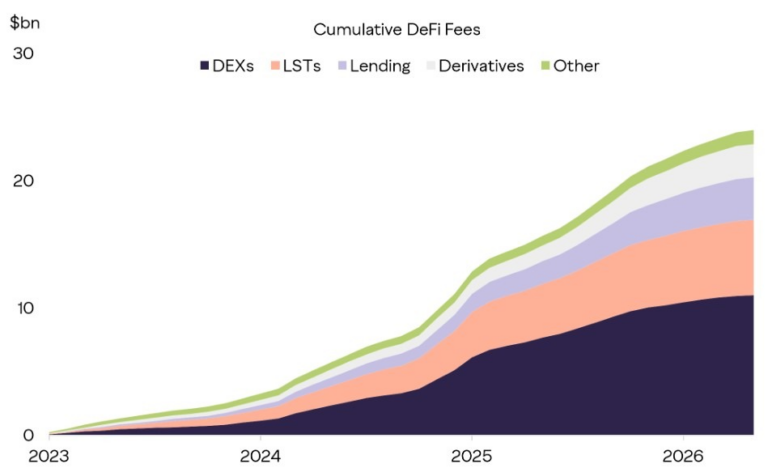
These reports arrive at a time when several major financial institutions are becoming increasingly bullish on decentralized finance.
Global banking giant Standard Chartered recently projected that the DeFi sector could reach a total market value of $2.7 trillion by 2030.
The bank also suggested that Uniswap could become one of the most important platforms for trading tokenized real-world assets in the coming years.
Growing collaboration between traditional financial institutions and DeFi protocols may become one of the major long-term catalysts for sector-wide expansion.
Market Outlook for Traders
For active crypto traders, reports like Grayscale’s are becoming increasingly important.
Institutional firms are no longer viewing DeFi simply as an experimental sector. Instead, they are beginning to apply measurable financial frameworks that could reshape long-term token valuations.
For AAVE, the $175 target represents a bullish long-term scenario, but traders should continue monitoring:
- DeFi lending activity
- Protocol revenue growth
- DAO governance decisions
- Broader Ethereum ecosystem performance
- Regulatory developments affecting DeFi markets
As institutional adoption increases, DeFi valuation narratives could become a major driver of future market cycles.