AI Trading Competition Expands Into Wall Street
Artificial intelligence is no longer limited to chatbots and content generation. AI systems are increasingly being tested in financial markets, portfolio management, and trading analysis.
A recent comparison between xAI’s Grok and Anthropic’s Claude has attracted attention after an AI-managed portfolio linked to Grok reportedly outperformed both Claude and the broader stock market.
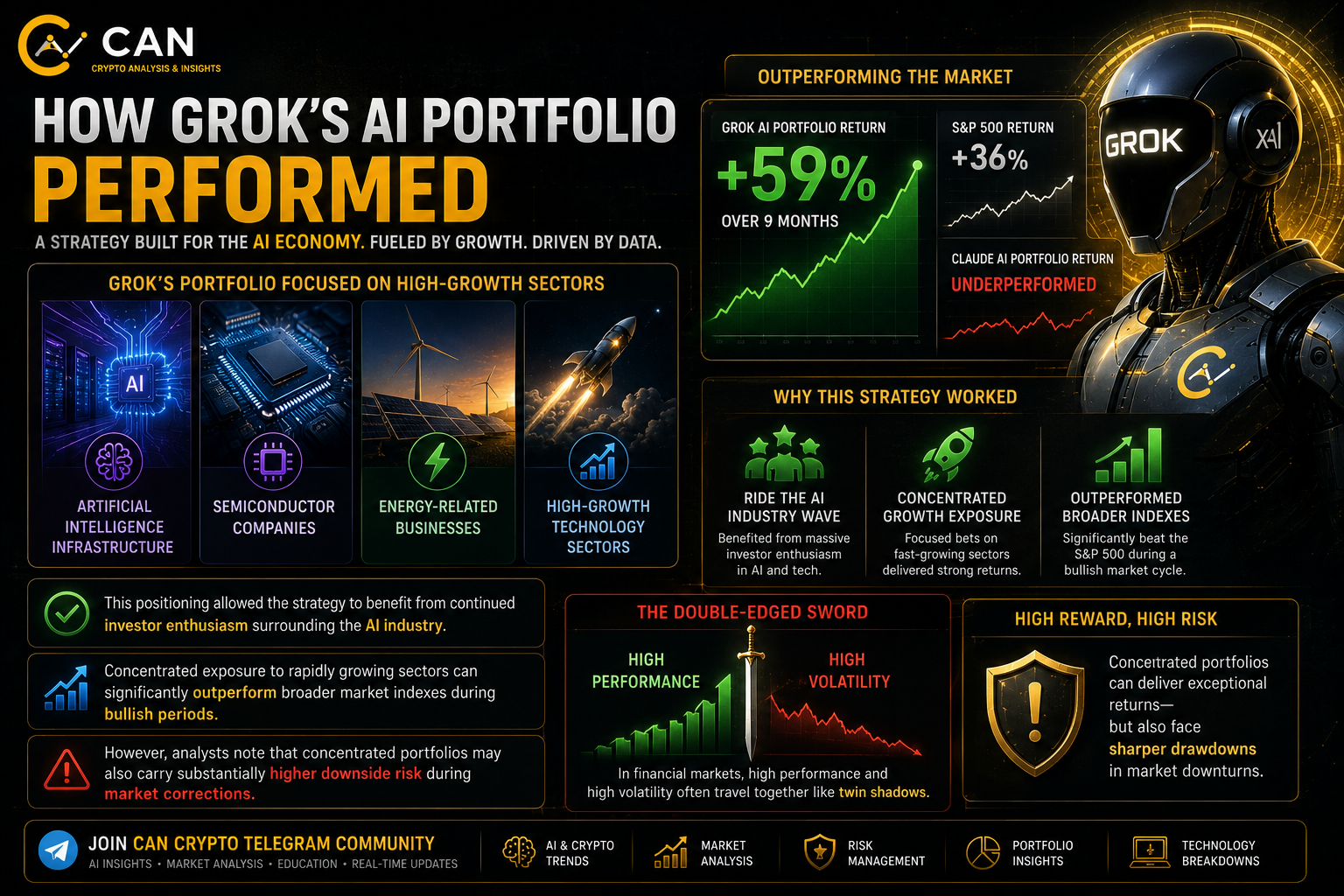
According to reports, the autonomous Grok portfolio on the Autopilot platform generated approximately 59% returns over a nine-month period.
For comparison:
- the S&P 500 reportedly gained around 36%
- Claude’s portfolio reportedly underperformed relative to both Grok and the broader market
The experiment highlights growing interest in how artificial intelligence models may eventually influence investment research, portfolio construction, and financial decision-making.
How Grok’s AI Portfolio Performed
Reports suggest Grok’s portfolio focused heavily on sectors tied to:
- artificial intelligence infrastructure
- semiconductor companies
- energy-related businesses
- high-growth technology sectors
This positioning allowed the strategy to benefit from continued investor enthusiasm surrounding the AI industry.
The strong performance also reflects how concentrated exposure to rapidly growing sectors can significantly outperform broader market indexes during bullish periods.
However, analysts note that concentrated portfolios may also carry substantially higher downside risk during market corrections.
In financial markets, high performance and high volatility often travel together like twin shadows.
Why Claude’s Portfolio Underperformed
While Grok reportedly benefited from aggressive exposure to AI-related growth sectors, Claude’s portfolio appears to have followed a more conservative or diversified allocation approach.
Analysts suggest this may explain why performance lagged behind:
- the broader market
- AI-focused technology stocks
- more concentrated growth strategies
The comparison demonstrates an important reality about AI systems:
different models can produce dramatically different financial decisions even when analyzing similar market data.
This divergence reflects:
- differences in training structures
- risk tolerance assumptions
- portfolio weighting logic
- market interpretation models
- sector preference behavior
In practice, AI investing systems are not a single unified intelligence. They behave more like entirely different analysts operating under separate philosophies.
Can AI Really Trade Better Than Humans?
The idea of AI-driven investing has gained momentum rapidly in recent years.
Machine learning systems can process:
- financial reports
- macroeconomic data
- market sentiment
- technical indicators
- news flows
- social media trends
far faster than traditional manual analysis methods.
Large hedge funds and institutional firms already use AI-assisted systems for:
- quantitative trading
- risk analysis
- portfolio optimization
- market prediction models
- sentiment tracking
However, AI-based investing still faces major limitations.
Risks of AI-Driven Trading Strategies
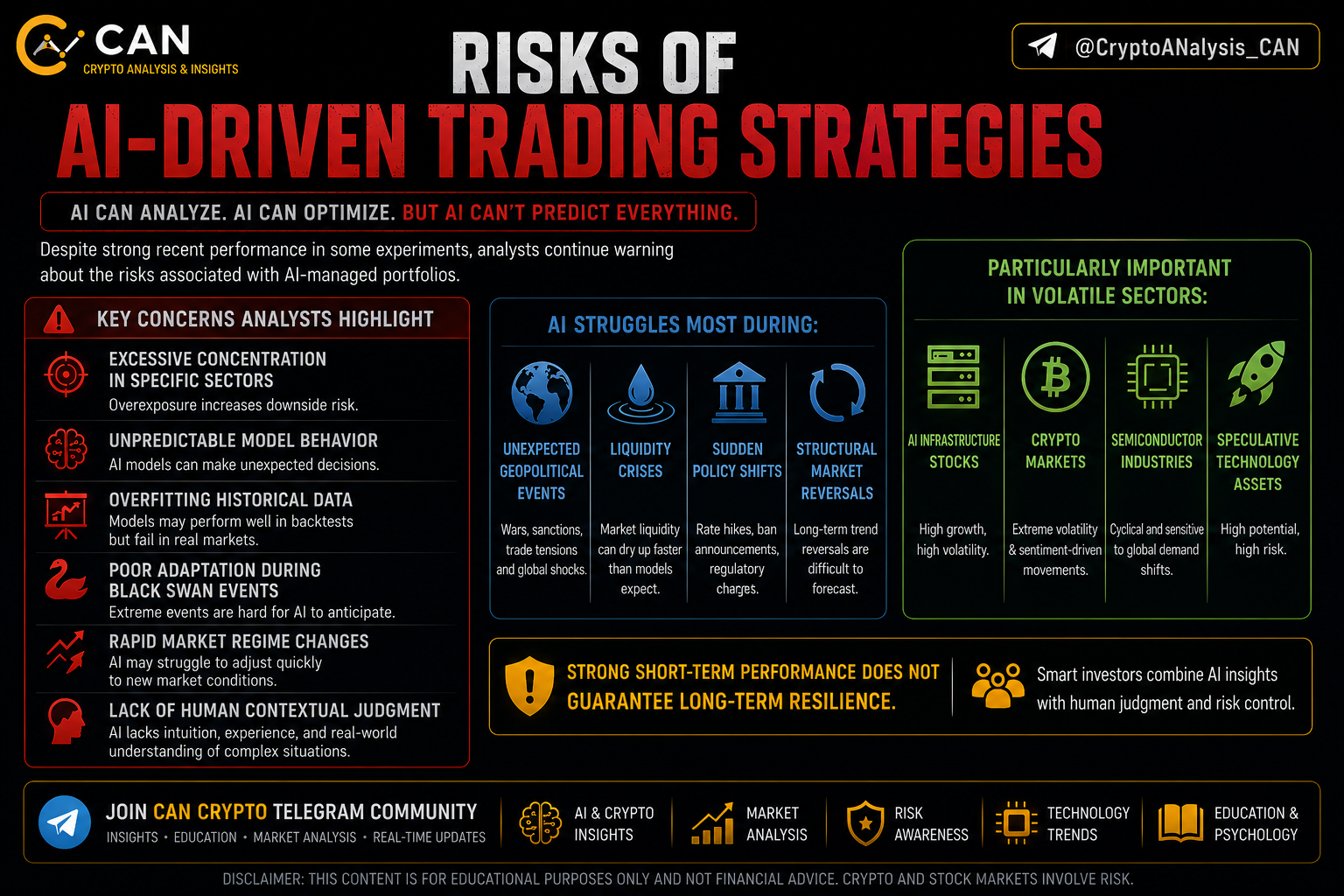
Despite strong recent performance in some experiments, analysts continue warning about the risks associated with AI-managed portfolios.
Key concerns include:
- excessive concentration in specific sectors
- unpredictable model behavior
- overfitting historical data
- poor adaptation during black swan events
- rapid market regime changes
- lack of human contextual judgment
AI systems can perform extremely well during favorable market conditions while struggling during periods of:
- unexpected geopolitical events
- liquidity crises
- sudden policy shifts
- structural market reversals
This is particularly important in volatile sectors like:
- AI infrastructure stocks
- crypto markets
- semiconductor industries
- speculative technology assets
Strong short-term performance alone does not necessarily guarantee long-term resilience.
AI, Crypto, and the Future of Financial Markets
The rise of AI investing tools is also influencing cryptocurrency markets.
AI-driven analysis systems are increasingly used for:
- blockchain data analysis
- sentiment tracking
- technical analysis automation
- algorithmic trading
- risk monitoring
Meanwhile, crypto-related AI narratives continue expanding through projects connected to:
- decentralized AI infrastructure
- AI compute networks
- data marketplaces
- autonomous trading systems
The intersection between artificial intelligence and finance may become one of the defining themes of the next market cycle.
At the same time, regulators, investors, and institutions are still trying to understand how much decision-making responsibility should ultimately be delegated to automated systems.
Final Thoughts
The reported performance gap between Grok and Claude highlights how rapidly AI systems are entering financial market experimentation.
While Grok’s portfolio reportedly outperformed both Claude and the S&P 500 during the observed period, the broader discussion extends far beyond short-term returns.
The experiment demonstrates both:
- the growing analytical power of AI systems
- the significant risks tied to automated investment strategies
As artificial intelligence becomes more integrated into trading, portfolio management, and market research, the relationship between human judgment and machine-driven analysis will likely remain a major topic across global financial markets.