IMF: Tokenization Is No Longer Just a Crypto Story
The International Monetary Fund has made one of its clearest statements yet on blockchain's role in mainstream finance: tokenization isn't a niche crypto experiment anymore, it could fundamentally reshape how financial markets operate. That's a notable shift in tone from a global policy institution that has historically approached crypto with caution.
For traders and institutions watching the intersection of TradFi and blockchain, this matters. When the IMF starts talking about shared ledgers cutting settlement times from days to seconds, it's signaling that tokenized finance is moving from theory to infrastructure. (Cointelegraph)
Key Takeaways
- The IMF says tokenization could transform financial market infrastructure, not just crypto trading.
- Settlement times could shrink from multiple days to near-instant transactions.
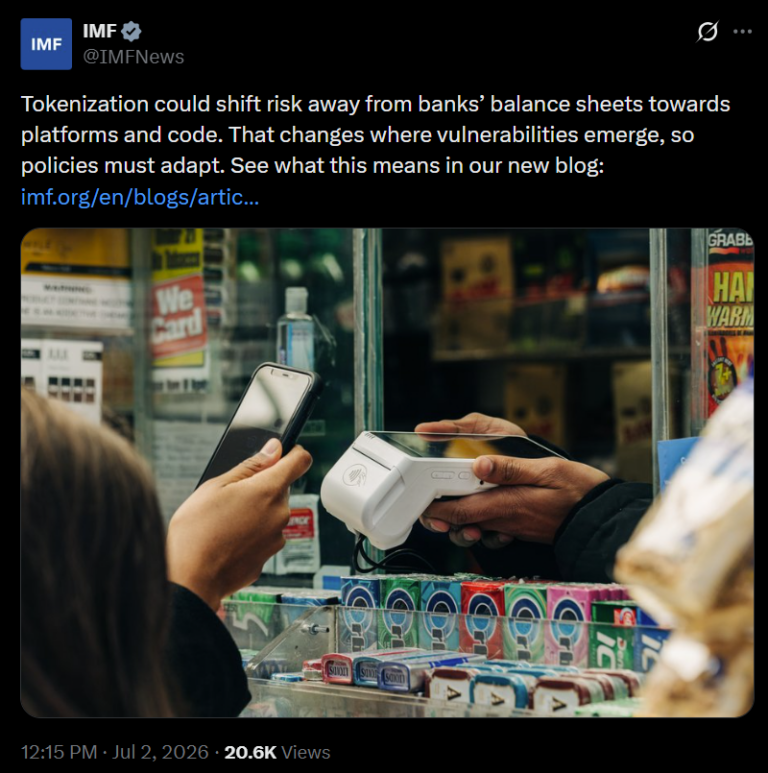
- Risk is shifting from traditional intermediaries toward smart contracts and tech infrastructure.
- Without unified standards, fragmented tokenized markets could create new systemic risks.
- The SEC is exploring an "Innovation Exemption" for tokenized securities trading.
From Days to Seconds: How Tokenization Changes Settlement
In a note published Thursday, Tobias Adrian, the IMF's Financial Counsellor and Director of the Monetary and Capital Markets Department, laid out the core case for tokenization. By moving assets, settlement, and record-keeping onto a shared ledger, the multi-day settlement process common in traditional finance today could compress into near-instant transactions.
For traders, this isn't an abstract efficiency gain. Faster settlement means less counterparty risk sitting in the system at any given time, tighter capital efficiency, and fewer delays around margin and collateral movement, the kind of structural improvement that eventually shows up in tighter spreads and deeper liquidity.
The Other Side: Where the Risk Moves
Adrian was equally direct about the downside. Tokenization doesn't eliminate risk, it relocates it. As settlement shifts away from traditional intermediaries, exposure moves toward the technology layer itself: smart contracts, distributed ledgers, and the service providers running them.
His warning was specific: without common standards and coordinated regulation, tokenized markets risk fragmenting into incompatible, non-interoperable platforms. That fragmentation, rather than the technology itself, is what he flagged as the real source of potential systemic risk.
This is a familiar pattern to anyone who's watched DeFi infrastructure mature; bridges, wrapped assets, and cross-chain protocols have all demonstrated how interoperability gaps become attack surfaces or liquidity traps when standards aren't aligned.
Institutions Are Already Building
The IMF's note lands as traditional finance moves faster than the regulatory conversation around it. The Clearing House backed by JPMorgan Chase, Bank of America, and Barclays is reportedly planning to launch a tokenized deposit network in early 2027, designed to keep deposits inside the regulated banking system while enabling faster, programmable payments.
This aligns with separate research from PwC, which found that tokenization could resolve longstanding inefficiencies in payment settlement and asset ownership transfer. It also follows a May study from Moody's showing traditional financial institutions are actively preparing for a shift toward tokenized finance infrastructure.
The pattern across all three reports is consistent: this isn't speculative positioning from crypto-native firms. It's balance-sheet-level institutions building toward tokenization as infrastructure, not as a trade.
Regulators Are Racing to Define the Rules
The IMF's report puts particular weight on the role of regulators in shaping how tokenized finance evolves. Adrian noted that policymakers have a limited window to influence the market's trajectory, decisions on settlement assets, governance frameworks, interoperability standards, and the role of central banks will determine whether tokenization improves financial efficiency or introduces new systemic risk.
In the U.S., the SEC has started clarifying how existing securities law applies to tokenized assets, without creating a separate regulatory framework specifically for them. The agency is also reportedly exploring an "Innovation Exemption" a mechanism that would let market participants test blockchain-based trading platforms for tokenized securities in a sandbox environment before a long-term regulatory structure is finalized.
What This Means for Traders and the Broader Market
Institutional tokenization moving into mainstream finance is a slower, less headline-driven story than a token launch or an ETF approval, but it's arguably more structurally significant. If major banks succeed in building tokenized deposit and settlement infrastructure by 2027, it changes the plumbing underneath both TradFi and crypto markets simultaneously.
For traders, the near-term takeaway isn't a specific trade , it's a signal to watch. Regulatory clarity around interoperability standards, especially from the SEC's Innovation Exemption process, will likely determine which blockchain infrastructure providers and Layer 1/Layer 2 ecosystems end up positioned to serve institutional settlement flows. That's a theme worth tracking well before it becomes consensus.