Cambridge Research Maps Where Ethereum's Nodes Actually Live
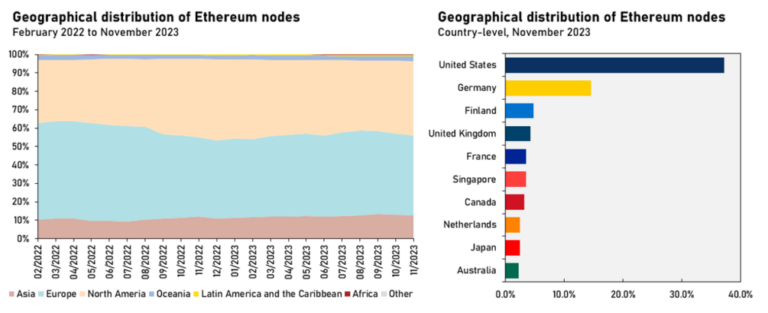
A new study from the (Cambridge Centre) for Alternative Finance, published Friday, puts hard numbers behind something the Ethereum community has long suspected: node distribution is heavily concentrated in the West. Roughly a third of Ethereum nodes run in the United States, with another 39% spread across the European Union (excluding the UK).
Alexander Neumueller, the center's research lead, frames the picture as West-heavy without being dominated by any single country. That distinction matters, but so does the fact that "not one country" still leaves the network dependent on a fairly narrow set of jurisdictions and hosting providers.
Why the "One-Third" Threshold Matters
Neumueller pointed to Hetzner, AWS, and OVH as the three hosting providers around which node infrastructure has clustered. Hetzner's terms of service reportedly banned blockchain node operations at one point, though Neumueller noted that policy may have since changed, worth flagging as a live variable rather than a settled fact.
The more technically important detail: Ethereum doesn't need half its validators offline to disrupt the live network. Based on Cambridge's research, once more than a third of nodes go offline simultaneously, checkpoint finalization stops entirely. That's a meaningfully lower bar than most people probably assume.
He also flagged something less discussed, the relationship between nodes and validators isn't one-to-one, and nobody actually knows precisely how many validators sit behind any given node. That opacity makes it harder to model exactly how fragile the one-third threshold really is in practice.
Why Node Location Is a Legal Question, Not Just a Technical One
Node concentration carries real legal weight, and there's precedent here. In 2022, the U.S. Securities and Exchange Commission argued it could claim jurisdiction over Ethereum specifically because most nodes were located in the United States, reasoning that transactions could therefore fall under U.S. securities law.
Neumueller described current distribution as healthy, though he was careful to frame that as personal opinion rather than a formal research finding. Still, he noted it's something the community needs to keep watching. In his words, geographic distribution of nodes is desirable for a network, and client software concentration creates a parallel risk, a bug in a dominant client could propagate across the entire network.
That second point is arguably the sharper warning here: even well-distributed nodes don't help much if they're all running the same client software with the same vulnerability.
Energy Consumption: The Numbers Get a Refresh
The report, titled "Ethereum After the Merge," rebuilds the methodology behind Cambridge's earlier energy estimates, replacing theoretical assumptions with empirical data on how nodes actually split between residential and commercial hosting.
Neumueller said the update was prompted by Ethereum's post-Merge network upgrades, since software changes can shift how hardware consumes energy in ways that aren't always predictable from the outside.
The headline figures: Ethereum now consumes roughly 7.9 gigawatt-hours annually, equivalent to about one megawatt of continuous power, or the electricity use of around 2,000 UK households. That's a drop of approximately 99.98% from pre-Merge levels. Sustainable energy use across the network has now crossed 56%, well above the global average of 43%.
Neumueller also put a number on Ethereum's remaining carbon footprint: offsetting the network's total annual emissions using high-quality, nature-based carbon removal credits would cost between £25,000 and £55,000 (roughly $33,500-$73,800). He noted that's about the price of a car and said that comparison surprised him more than any other finding in the report.
A Note on Independence
Neumueller acknowledged the Ethereum Foundation supported the research and thanked the organization for making the new estimates possible. But he was explicit that he hadn't discussed decentralization findings directly with the Foundation, his read on how much decentralization matters to them is based on the Foundation's public statements, not anything communicated to him directly. Worth noting for anyone weighing how independent this analysis actually is.
What This Means for Ethereum Holders and Traders
None of this changes Ethereum's fundamentals overnight, but it's a useful data point for anyone tracking regulatory risk around ETH. A jurisdiction-based legal argument resurfacing similar to the SEC's 2022 reasoning, isn't a zero-probability event, especially with node concentration sitting exactly at the threshold Cambridge flags as risky for network finalization.
The energy story, by contrast, is a clear positive: a 99.98% reduction post-Merge is a hard number that undercuts one of the more persistent criticisms of the network pre-2022. That's worth keeping in your back pocket if ESG-related narratives around Ethereum come up in trading discussions or institutional adoption debates.