SpaceX Stock Surges After Historic IPO as Analysts Warn of Potential Tesla-Style Correction
Just days after its record-breaking public debut, SpaceX stock (SPCX) has become one of the most closely watched assets in global markets. Following an explosive post-IPO rally, traders are now debating whether the company could continue its momentum or face a sharp correction similar to what happened with Tesla stock (TSLA) after its 2010 listing.
While investor demand remains extremely strong, some market analysts believe the current valuation raises serious questions about sustainability.
SpaceX Delivers the Largest IPO in Market History
On June 12, SpaceX officially entered the public markets with an IPO price of $135 per share, raising approximately $75 billion in fresh capital.
This instantly surpassed the previous record held by Saudi Aramco, which raised $25.6 billion during its 2019 public offering, making SpaceX the largest IPO in history.
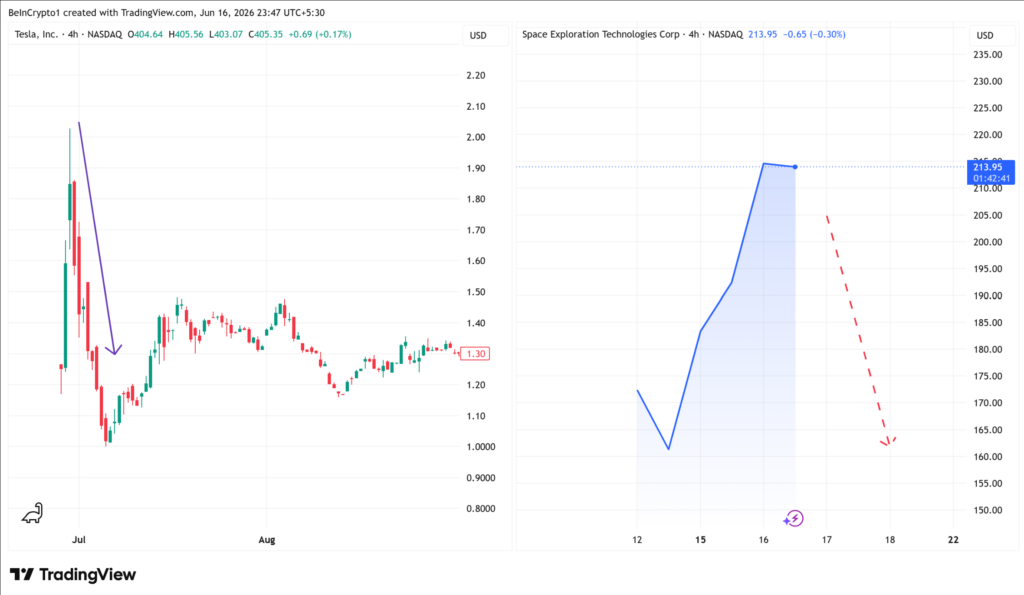
Since launch, SPCX stock has gained nearly 56%, recently trading around $213.95 per share.
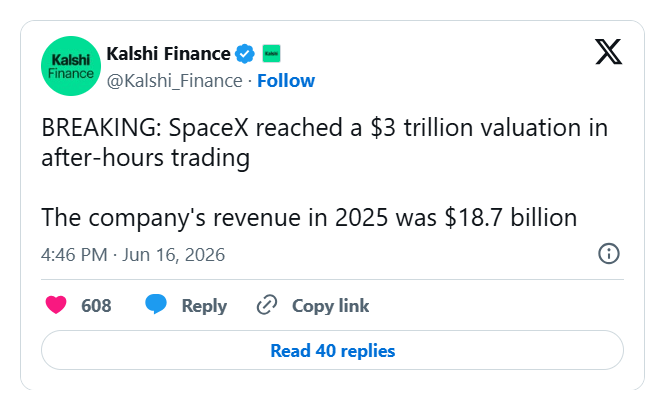
According to prediction market platform Kalshi, SpaceX’s valuation has now reached roughly $3 trillion, backed by estimated 2025 annual revenue of $18.7 billion.
The scale of this valuation has drawn major attention from institutional traders, especially as it significantly exceeds valuation multiples seen during Tesla’s early public market days.
Why Some Traders Expect a Sharp SpaceX Correction
Despite the strong rally, several analysts have begun warning that SPCX could be entering an overheated phase.
Market analyst Ted Pillows recently shared a bearish outlook, arguing that SpaceX appears to be following a pattern similar to Tesla’s IPO in 2010.
Tesla debuted at $17 per share, finishing its first trading day up roughly 40.5%. Within months, the stock nearly doubled before experiencing a sharp decline that erased nearly a quarter of its market value in a short period.
Ted Pillows summarized the comparison by saying:
- SpaceX (SPCX) is following Tesla’s path. An initial 60–70% rally followed by a brutal 50% correction.
Other investors share similar concerns.
Investor Joe Bacardi believes downside pressure could begin emerging in August, citing several structural risks including:
- Low public float
- Forced ETF buying activity
- Extremely aggressive valuation multiples
- Nearly 90x projected 2026 revenue valuation
As a result, some traders believe current price action resembles speculative momentum rather than healthy price discovery.
Meme Coin Style Momentum Is Raising Concerns
Even mainstream financial commentators have started paying attention to SpaceX’s unusual price behavior.
CNBC host Jim Cramer recently said that while he likes SpaceX as a company, he feels uncomfortable watching the stock move in what resembles meme coin-style trading conditions.
His concern mainly centers around the lack of active sellers, which can create unstable price expansion during early market trading.
This behavior often attracts short-term momentum traders, increasing volatility risk significantly.
Why SpaceX Bulls Believe the Rally Can Continue
Not all analysts agree with the bearish outlook.
Some investors argue that comparing SpaceX directly to Tesla oversimplifies current market dynamics.
Investment advisor Thierry Bourgeat believes the same scarcity driving SpaceX’s aggressive valuation may also be preventing a major correction.
According to him:
- Yes, SpaceX stock looks expensive by traditional valuation standards… but price does not fall simply because it should. It falls when sellers outnumber buyers. Scarcity works both ways.
Demand for SpaceX shares remains exceptionally strong.
Bloomberg ETF analyst Eric Balchunas recently noted that the number of exchange-traded funds (ETFs) holding SPCX increased from 4 funds to nearly 120 funds within just a few trading sessions.
This suggests institutional demand continues accelerating rapidly.
August Could Become the First Major Stress Test
For now, one factor continues supporting the stock: limited supply.
Company insiders remain restricted by lock-up agreements, meaning a significant portion of shares cannot yet be sold into the market.
At the same time, retail investors appear unwilling to take profits aggressively.
This imbalance between buyers and sellers continues pushing price upward.
However, many traders are closely watching August, when insider lock-up restrictions may begin expiring.
If a large number of early shareholders decide to sell, market supply could increase dramatically, creating the first real test for current valuations.
Market Outlook: Momentum vs Fundamentals
At the moment, SpaceX stock appears to be trading primarily on scarcity, market sentiment, and investor enthusiasm rather than traditional fundamentals.
The company remains one of the strongest private-sector innovation stories globally, but valuation levels have moved far ahead of revenue growth metrics.
For traders, the coming months could determine whether SPCX follows a long-term growth trajectory similar to Tesla or experiences a sharp correction before stabilizing.
As always, monitoring liquidity, institutional positioning, and insider activity will likely be more important than watching price alone.