Why Ethereum Continues to Face Resistance
Ethereum (ETH) has repeatedly failed to maintain momentum above the $2,400 level over the past several months, raising concerns among traders about the asset’s short-term strength. While the broader crypto market has also experienced pressure in 2026, Ethereum’s performance has remained noticeably weaker compared to many competing digital assets.
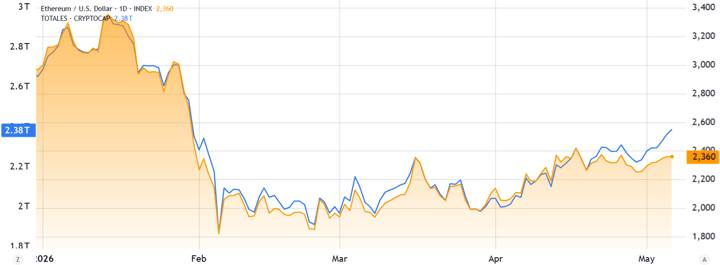
ETH is currently down roughly 21% since the start of the year, while the total cryptocurrency market capitalization has declined by around 11% during the same period. This growing performance gap suggests that Ethereum is facing several ecosystem-specific challenges beyond general market weakness.
A combination of declining decentralized application activity, increasing blockchain competition, and weaker institutional sentiment appears to be limiting Ethereum’s upside potential.
Declining DApp Activity Is Hurting Ethereum
One of the biggest concerns surrounding Ethereum is the sharp slowdown in decentralized application (DApp) usage across the network.
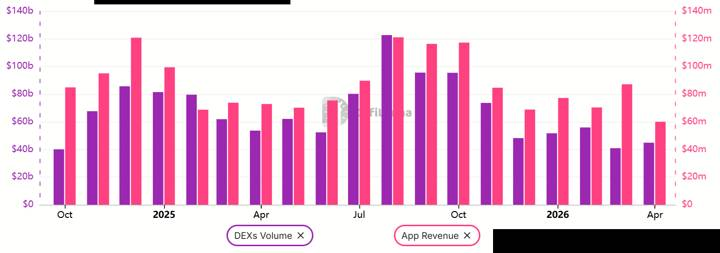
Over the past six months, decentralized exchange (DEX) trading volume on Ethereum has dropped by approximately 53%, significantly reducing network activity and transaction demand. As a result, DApp revenues have also fallen nearly 49% during the same period.
This slowdown has been partially driven by:
- The collapse of meme coin speculation
- Lower new token issuance
- Reduced retail trading activity
- Weakening market sentiment
However, another important factor has been the growing number of security incidents across the crypto industry.
According to recent industry reports, the crypto sector suffered roughly $630 million in hacks during April alone. Around 82% of those losses were linked to incidents involving KelpDAO and Drift Protocol, with researchers reportedly attributing some attacks to North Korean-linked hacker groups.
The impact of these security breaches has negatively affected overall trust and activity across decentralized finance platforms, including Ethereum-based protocols.
Competition From Other Blockchains Continues to Increase
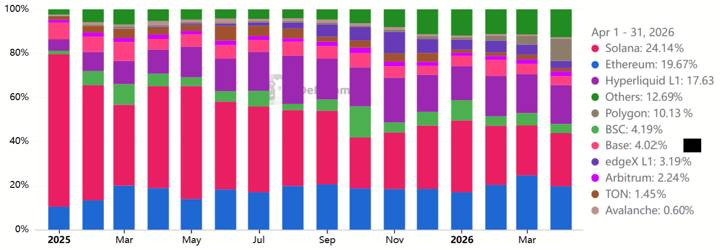
Ethereum still remains the dominant blockchain ecosystem overall, especially when its layer-2 infrastructure is included. However, competing networks are steadily capturing larger portions of user activity and DApp revenue.
Networks like Solana and Hyperliquid have increasingly focused on improving base-layer scalability directly instead of relying heavily on layer-2 rollups. This approach has simplified the user experience for many retail participants.
Combined, Solana and Hyperliquid now account for roughly 42% of total DApp revenue market share despite Ethereum maintaining a significantly larger total value locked (TVL).
This trend highlights an important challenge for Ethereum:
Many users still struggle to fully understand the need for rollups and multi-layer scaling systems, particularly as competing chains continue offering simpler and faster on-chain experiences.
Ethereum’s Scaling Upgrades Still Face Market Uncertainty
Ethereum developers continue working toward major network upgrades designed to improve scalability and transaction efficiency.
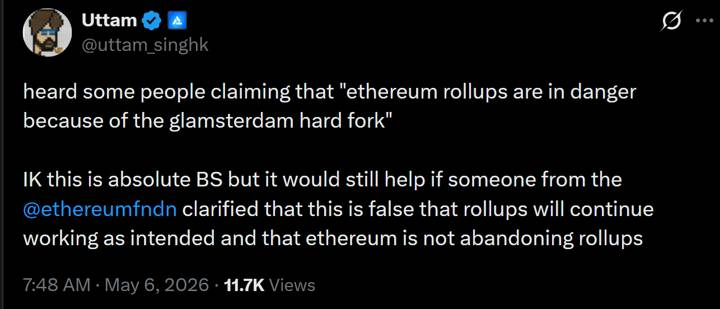
One upcoming upgrade known as “Glamsterdam” is expected to increase base-layer capacity significantly while enabling clients to receive block data earlier. This could eventually support more efficient parallel transaction execution across the network.
Some parts of the market initially misunderstood the upgrade and incorrectly assumed it could negatively impact Ethereum rollups. However, developers have clarified that the goal is to improve scalability while maintaining Ethereum’s broader ecosystem structure.
Even so, uncertainty remains regarding whether these upgrades will meaningfully increase network fee generation and staking profitability over the long term.
For many investors, Ethereum’s roadmap still appears technically complex compared to alternative blockchain ecosystems offering more straightforward user experiences.
Institutional Demand for ETH Has Also Weakened
Institutional sentiment surrounding Ethereum has faced additional pressure in recent months.
BitMine, currently one of the largest publicly traded holders of ETH, reportedly spent around $12.2 billion accumulating Ethereum. However, the current estimated value of those holdings has fallen to roughly $10.8 billion.
Although this unrealized loss does not necessarily indicate immediate selling pressure, it has reduced confidence among some institutional participants considering larger Ethereum exposure.
Institutional investors typically prioritize:
- Stability
- Clear growth narratives
- Strong revenue generation
- Market leadership consistency
Ethereum’s recent underperformance compared to parts of the broader crypto market has complicated that narrative.
Can Ethereum Still Recover?
Despite these challenges, Ethereum remains one of the most important assets in the crypto market and continues to dominate several major sectors including decentralized finance, staking, and layer-2 infrastructure.
However, ETH currently faces three major obstacles:
- Declining on-chain activity
- Intensifying blockchain competition
- Weaker institutional confidence
These factors do not necessarily prevent Ethereum from eventually moving toward higher price levels such as $2,800 and beyond. Still, they continue to slow momentum and contribute to ETH underperforming the broader cryptocurrency market in 2026.
Traders are now closely watching whether Ethereum can regain network activity and strengthen investor sentiment before another major breakout attempt develops.